Anyone with internet access can read the textbook legal definition of an electric bike on GOV.UK: 250 watts maximum, 15.5 mph assistance limit, no throttle above walking pace (which we break down in detail in our UK electric bike law guide). But if you are researching electric moped law UK or trying to understand electric bike registration rules, you already know that the official guidance is completely detached from what is happening on British streets.
Whether you searched for electric moped uk law, wanted to know the latest electric moped rules uk, or need to know if your high-power conversion kit requires ebike registration with the DVLA, you are probably stuck in the exact same grey area: you have bought a 500W, 750W, or 1000W bike, and discovered that under current electric moped laws, your bicycle is technically classed as a motor vehicle.
The law treats your 750W bicycle identically to a 50 mph Sur-Ron electric dirt bike, the DVLA makes registration nearly impossible for converted or direct-imported bikes, and the police are seizing machines left, right, and centre. Here is the honest, unfiltered truth from someone who has actually lived it.
“I Rode a 750W Bike Doing Food Deliveries: Here is the Reality”
When I was delivering food, I rode a 750-watt electric bike every day on public roads with no tax or insurance. Being a food delivery rider is a tough job. 250 watts is fine for a leisurely weekend spin, but for this kind of work, it simply is not enough.
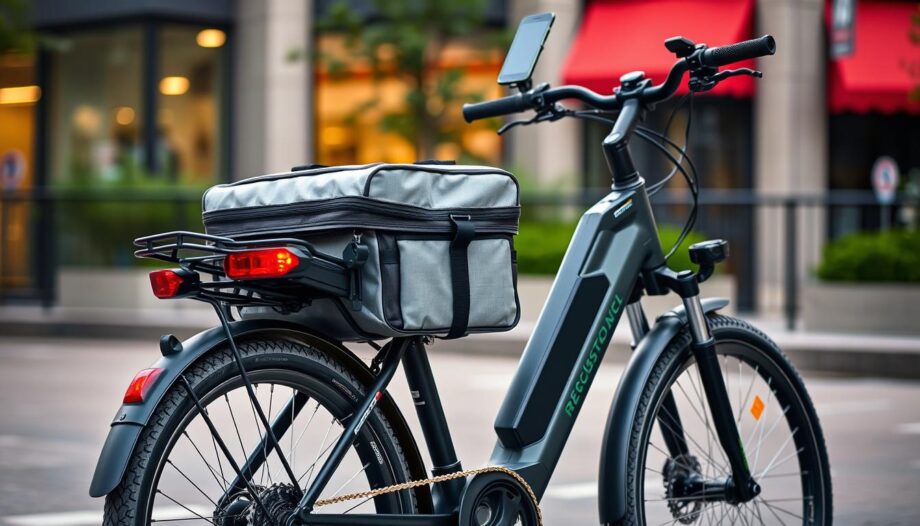
People will say “well, do not do the job then”, but at the time I needed the money. Taking an illegal bike on the road was something I thought about a lot beforehand. I knew the risk of losing the bike, and it was definitely not because I wanted to break the law. Getting up and down steep hills carrying heavy loads (I even had a basket on the front to carry stuff) meant I needed that extra power to get through a shift.
It was also great fun to ride. I did not ride like an idiot, and I averaged around 15 mph anyway. I was never stopped once, and I even spoke to police officers about my bike while out on jobs. Because it was just one of those fat bikes with pedals, it did not look like a motorcycle.
I was not tearing about or bothering anyone, but under the strict letter of UK law, I was technically in the exact same bracket as someone on an unregistered 12,000-watt electric dirt bike. That is the dilemma thousands of riders face every day.
What is the Legal Difference Between an Electric Moped and an E-Bike?
⚡ The 30-Second Legal Reality Check
Before we dive into the grey area, here is the official line that separates bicycles from motor vehicles under UK law:
Motor capped at 250W continuous, pedal-assist cuts out at 15.5 mph (25 km/h), pedals must propel it. Age 14+. No licence, no CBT, no DVLA registration, no road tax, and zero motor insurance required. Permitted in cycle lanes.
Motor up to 4kW (4000W), speeds up to 28-30 mph, twist throttle allowed. Requires DVLA registration, V5C logbook, rear number plate, CBT certificate, third-party insurance, and motorcycle helmet. Strictly banned from cycle lanes.
Looking for Bicycle Speed Limits, 250W Continuous vs Peak Power, or Battery Range?
This page covers the legal boundary where electric two-wheelers become motor vehicles (mopeds, V5C logbooks, CBT training, and insurance). If you are looking for statutory pedal cycle rules, whether you can pedal over 15.5 mph, 250W rated vs peak motor output (Bosch/Shimano), or 48V battery calculations, see our main guide:
The Impossible Catch-22: Why You Cannot Insure a 500W, 750W, or 1000W E-Bike
Here is the dilemma that hundreds of riders message me about every month. You buy a 750W fat tyre e-bike or convert your hardtail with a 1000W Bafang mid-drive. You want to do the right thing. You think: “Right, it has more than 250 watts, so it is technically an electric moped. I will just get it inspected, buy third-party insurance, and pay road tax so I am completely street legal.”
Good luck with that. You are about to hit an impenetrable legal brick wall:
The Inspection Trap: Why You Cannot Pass the MOT and Cannot Get Insured
Can you technically get an MOT for a modified or high-wattage e-bike? Yes, theoretically. But it is brutally difficult, and you cannot just wheel it down to your local garage for Barry to have a quick look at over a cup of tea. It has to go to a specialized DVSA test centre for a Motorcycle Single Vehicle Approval (MSVA) inspection. And that is where the dream dies:
- Specialist Test Centres Only: Ordinary MOT garages are not licensed or equipped to test unregistered electric vehicles. You must book into a regional DVSA test facility alongside kit cars and commercial prototypes.
- The Brakes Are a Massive Issue: The test centre puts the bike on heavy-duty motorcycle roller brake testers or uses precision deceleration meters. Standard bicycle disc brakes, lightweight levers, and thin 1.8mm bicycle rotors simply do not have the hydraulic fluid volume or stopping power to hit the mandatory motorcycle brake efficiency ratios. Most fail right here.
- Motorcycle Equipment Standards: The bike must feature E-marked motorcycle-grade lights wired into a permanent ignition loom, an electric horn that hits strict decibel minimums at 7 metres, an E-marked shatterproof offside mirror, an approved speedometer, and DOT-rated motorcycle tyres (standard bicycle rubber will fail).
- No EMC Radio Certificate: Government inspectors require official Electromagnetic Compatibility (EMC) test documentation proving the motor and controller do not emit radio frequencies that interfere with emergency services. Direct-import Chinese kits never include this.
- No Pass Means No Registration, No MOT, and Zero Insurance: Because your bicycle frame and brakes cannot pass this grueling motorcycle test, you cannot obtain an MSVA pass certificate or MOT. Without that, the DVLA will not issue a V5C logbook, and without a registration or MOT, no insurance company in the UK will sell you a policy.
The Reality: The law insists you must have insurance and tax to ride on the road, but makes insurance legally conditional on passing an inspection and MOT test that a bicycle is physically incapable of passing. You are locked out before you even begin.
The armchair lawyers and government officials will tell you: “Well, you simply should not buy those bikes, or you should only ride them on private land with the landowner’s permission.”
What an utter load of rubbish. Who owns hundreds of acres of private farmland in central Sheffield, Leeds, Manchester, or London? Nobody. People buy these bikes for practical urban transport, for delivering hot food to pay their rent, and for commuting without spending £3,000 on a train season ticket.
The E-Scooter Hypocrisy: UK Law is Already a Mess
If anyone tries to lecture you about strictly following UK micro-mobility law, just ask them to look out of their front window.
Every single day in every UK town and city, thousands of people commute to work on privately-owned electric scooters (which we break down in our dedicated UK electric scooter law guide). In the eyes of the law, every single one of those e-scooters is completely illegal to ride on public roads, cycle lanes, and pavements under Section 72 of the Highway Act 1835. Yet high street shops openly sell hundreds of thousands of them, and police forces generally turn a blind eye unless someone is riding recklessly or carrying contraband.
The law drew a rigid marker at 250 watts for bicycles decades ago, and because Parliament has moved at the speed of a punctured snail, technology has completely outpaced the rulebook. The result is a broken grey area where sensible, responsible commuters are criminalised while trying to get to work.
The Sledgehammer Approach: 750W E-Bikes vs Sur-Rons & Talarias
Here is the part that genuinely boils my blood: the complete lack of nuance in how the police and courts treat electric two-wheelers.
There is a world of difference between a 750-watt pedal-assist bicycle and a Sur-Ron or Talaria:
| Vehicle Type | Legal E-Bike (EAPC) | The Grey Area (500W-1000W) | Factory Electric Moped | Sur-Ron / Talaria (E-Moto) |
|---|---|---|---|---|
| Motor Output | 250W continuous | 500W to 1000W | 1500W to 4000W (4kW) | 6000W to 15,000W+ |
| Top Speed | 15.5 mph (25 km/h) | 20 to 28 mph | 28 to 30 mph | 45 to 65+ mph |
| Appearance | Standard bicycle | Bicycle with pedals | Scooter/moped styling | Full motocross dirt bike |
| Pedal Requirement | Mandatory | Usually fitted & active | None (footboards) | None (foot pegs) |
| Ability to Insure | Easy (£3-£10/mo) | Practically Impossible | Standard Moped Cover | Only if homologated |
| How Law Views It | Bicycle (No licence) | Motor Vehicle | Motor Vehicle | Motor Vehicle |
| Street Threat Level | Minimal | Low (ridden sensibly) | Low (road traffic) | Extreme if abused |
A Sur-Ron or Talaria is not an e-bike. It is an electric motocross motorbike. It has no functional pedals, pushes out up to 15,000 watts of explosive torque, reaches 50 to 65 mph, and has aggressive knobby tyres. When teenagers blast through pedestrian shopping centres on Sur-Rons wearing balaclavas, the public gets terrified, the newspapers print front-page outrage, and the police launch crackdown operations.
The tragedy is that the police crackdowns use a sledgehammer to crack a nut. Because the law has no middle category between a 250W pedal cycle and a motor vehicle, a sensible food courier or commuter cruising respectfully at 16 mph on a 500W hybrid gets caught in the exact same dragnet as a joyrider on an unplated dirt bike.
Electric Bike Registration: How to Register with the DVLA (V5C Logbooks)
Now, despite my personal opinions on how silly the system is, I have a duty of care to tell you exactly how the law operates. If you want to ride a machine over 250W with 100% legal immunity on British tarmac, here is the technical gauntlet you must run:
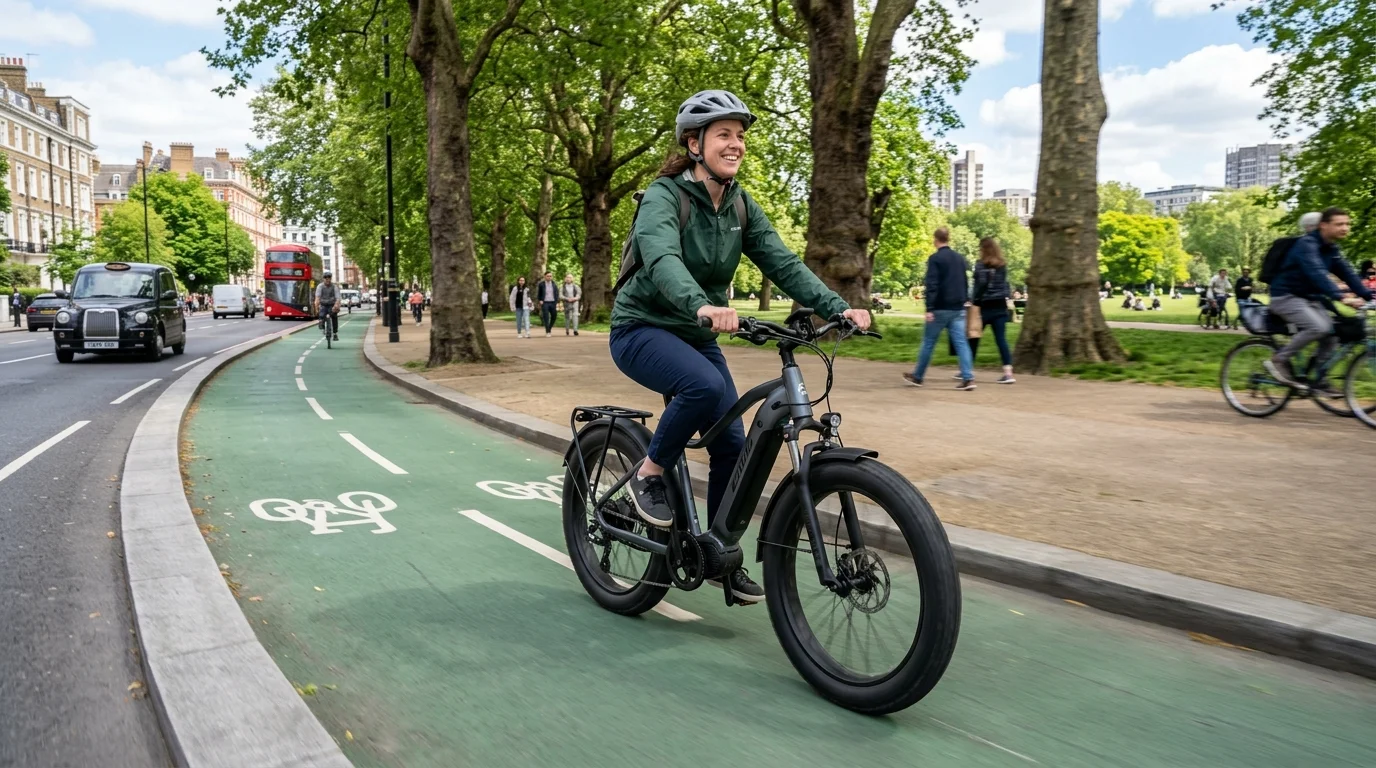
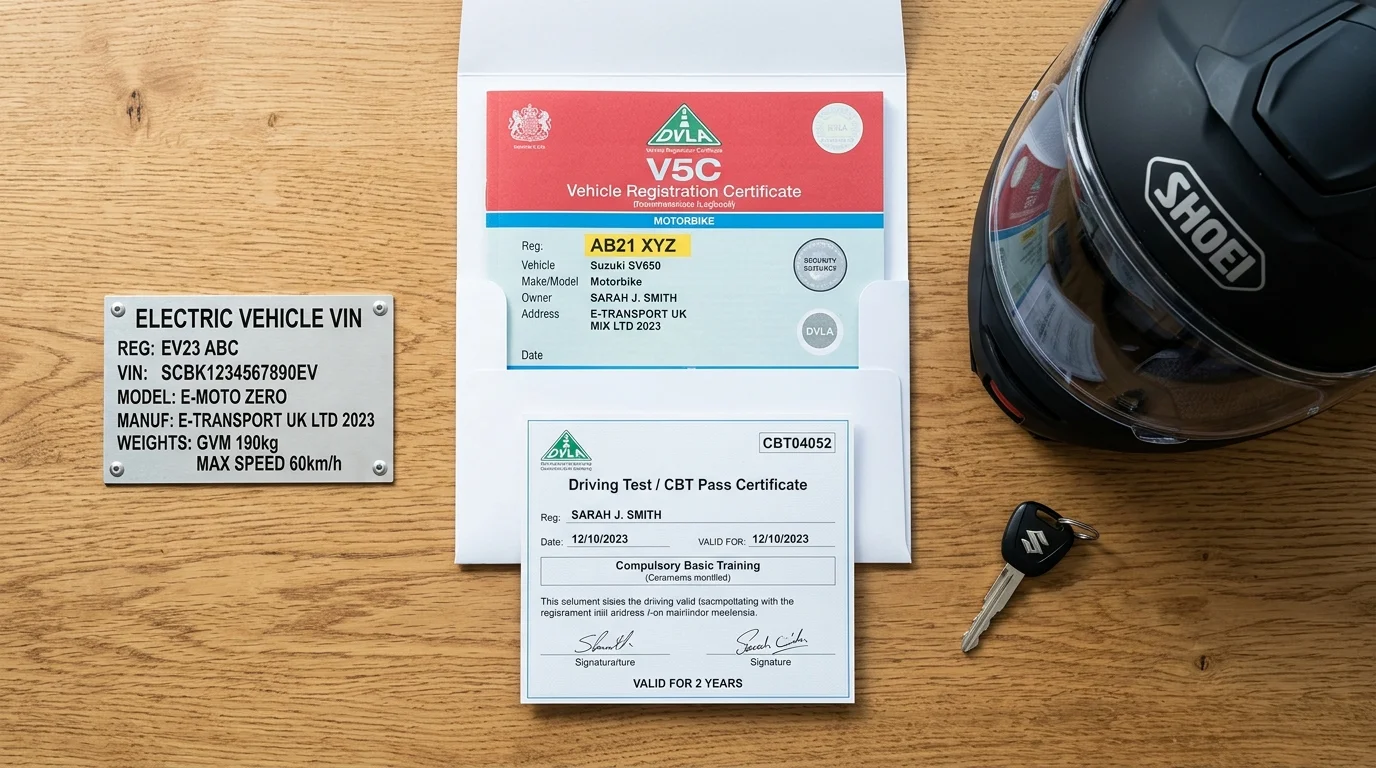
1. DVLA Registration and V5C Logbook
Any electric two-wheeler exceeding 250W continuous power or 15.5 mph assistance requires statutory electric bike registration (often referred to as an electric bicycle registration) as an L1e-A Speed Pedelec or L1e-B Electric Moped.
To register it, you need a European Certificate of Conformity (CoC) from the manufacturer. If you have an imported bike from AliExpress or a DIY conversion, you must book an appointment with the DVSA for a Motorcycle Single Vehicle Approval (MSVA) test. The test costs around £100, plus you must fit:
- An approved E-marked headlight, taillight, brake light, and indicators.
- An electric horn that meets decibel standards (a bicycle bell is not legal).
- An E-marked rear-view mirror on the offside.
- A certified speedometer readable in mph.
- A permanently stamped 17-digit VIN chassis plate.
Do You Need a CBT Licence, Road Tax, and Helmet for an Electric Moped?
2. Driving Licence and CBT Training
To ride an electric moped or speed pedelec on UK roads, you must be at least 16 years old. Your licence requirements depend on when you passed your car test:
- Car licence passed BEFORE 1 February 2001: You have grandfather rights (category AM). You can ride an electric moped without taking a CBT course and without L-plates.
- Car licence passed ON or AFTER 1 February 2001: You must complete a 1-day Compulsory Basic Training (CBT) course. Your CBT remains valid for as long as your full car driving licence is valid.
- Provisional Licence holders (age 16+): You must complete a CBT course to earn a DL196 certificate. It is valid for 2 years, you must display front and rear red L-plates, and you cannot carry passengers.
3. Motorcycle Helmet Requirements (ECE 22.06)
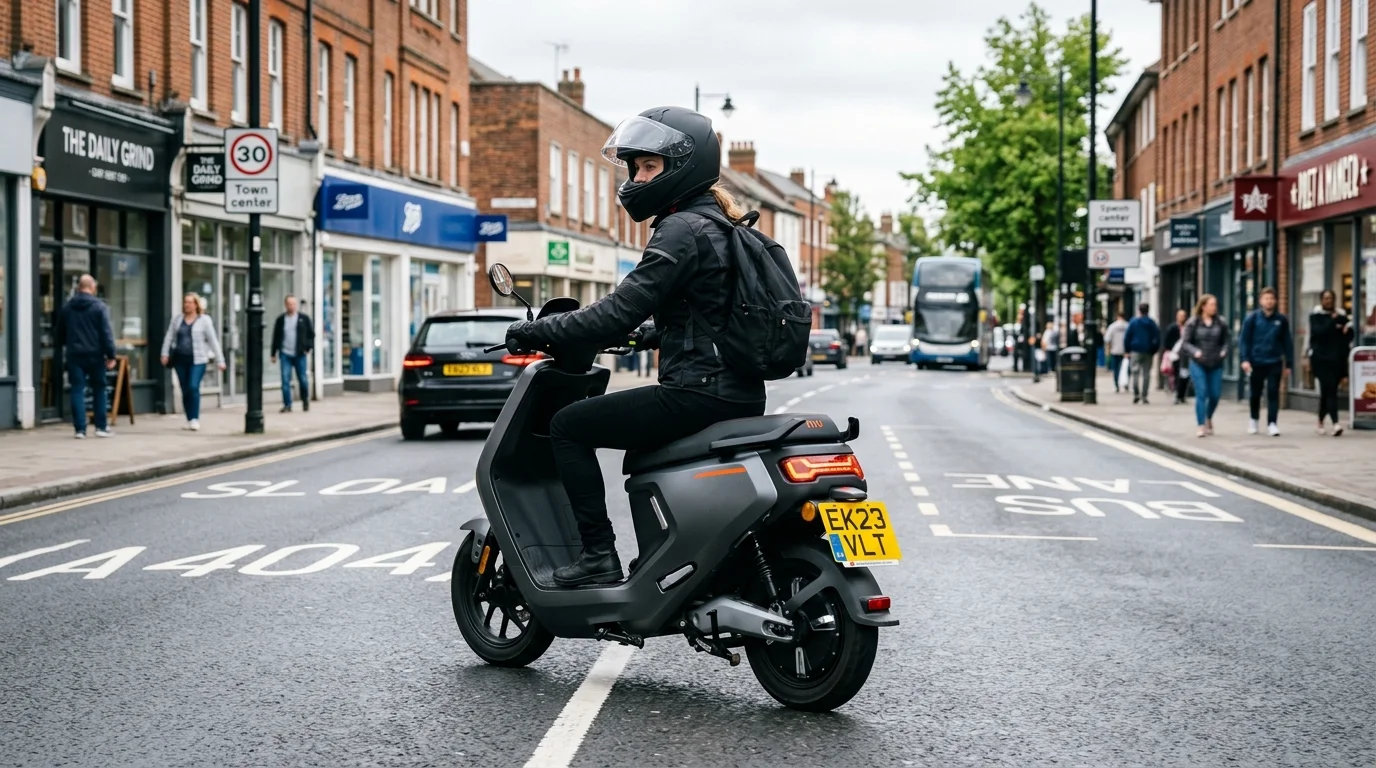
On a standard 250W e-bike, wearing a helmet is optional (though sensible). On an electric moped, wearing an approved motorcycle helmet is a strict legal requirement under Section 16 of the Road Traffic Act 1988.
Wearing a lightweight bicycle helmet (EN 1078) on an electric moped is illegal. Your helmet must conform to British Standard BS 6658:1985 or European standard UNECE Regulation 22.05 or 22.06.
4. Road Tax and Insurance
Because electric mopeds produce zero tailpipe emissions, Vehicle Excise Duty (road tax) is currently £0 per year. But you must still formally submit your £0 tax renewal through the DVLA website each year, or face an automatic £80 late fee. Third-party motor insurance is legally compulsory.
E-Bike Registration Check: How to Check if Your Electric Bike Needs DVLA Registration
Thousands of UK riders search for an e bike registration check every month. Usually, people are trying to figure out one of three things: whether their newly bought e-bike is legally exempt, whether an electric moped is properly logged on the DVLA database, or how to register their frame against bike theft.
Here is how to check your bike’s exact legal and registration status in under two minutes:
Inspect your bike frame and the hub/mid-drive motor casing. Under UK EAPC law, every street-legal electric bicycle must display an indelible manufacturer plate or tamper-evident sticker. It must clearly state the manufacturer name, a maximum continuous power output of no more than 250W, and an electrical cut-off speed of 15.5 mph (25 km/h). If your motor has a 500W, 750W, or 1000W stamp, or has no manufacturer compliance plate, it does not count as an exempt pedal cycle.
If you are buying a used electric moped, speed pedelec, or road-legal e-moto, you can run a free e-bike registration check using the official GOV.UK Vehicle Enquiry Service. Enter the registration plate displayed on the yellow rear plate. The DVLA database will instantly confirm the vehicle make, fuel type (Electricity), tax status, MOT history, and whether it is officially recorded as an L1e moped.
Do not confuse statutory DVLA vehicle registration with cycling security databases. If your e-bike is a standard 250W EAPC, you do not register it with the DVLA. Instead, you should register its frame number on BikeRegister (the UK National Cycle Database endorsed by police forces). This links your ownership to your frame number to deter thieves and help police return your bike if stolen, without any road tax or DVLA red tape.
Can Electric Mopeds Ride in Bus Lanes and Cycle Paths in the UK?
Public Roads Allowed
Both legal e-bikes and registered electric mopeds can use public carriageways. Restricted mopeds (28 mph) cannot use motorways.
Cycle Lanes & Tracks Mopeds Banned
EAPCs can use cycle tracks freely. Electric mopeds and 750W bikes are strictly illegal here; doing so risks 3 points and a £50 fine.
Bus Lanes Check Signage
Standard e-bikes can always use bus lanes. Electric mopeds can only use bus lanes if the blue sign shows a solo motorcycle symbol.
Pavements Strictly Illegal
Neither e-bikes, mopeds, nor e-scooters can be ridden on pedestrian pavements. Doing so is an offence under Section 72 of the Highway Act 1835.
Riding in the Real World: How to Survive the Grey Area
If you are currently riding a 500W, 750W, or 1000W electric bike, or thinking of buying one, here is my honest advice on how to navigate the reality on the ground:
1. How You Ride Dictates Your Fate
Traffic cops are not roaming the streets with microscopes checking the wattage laser-etched onto your hub motor shell, unless you give them a reason to look.
If you are pedalling at a sensible 15 to 18 mph, stopping at red lights, signalling with your arms, wearing a helmet, and giving way to pedestrians, you blend seamlessly into everyday cycling traffic. If you are sitting motionless with your feet propped on the frame, thumbing a throttle at 30 mph down a crowded shared footpath, you are practically begging to be pulled over and loaded onto a flatbed.
2. Keep the Visual Profile Clean
The bikes getting seized every weekend look like Mad Max war rigs. They have rat nests of exposed wiring dangling from the handlebars, giant uncovered battery bricks taped to the top tube, and exposed motors screaming for attention.
Keeping your cockpit tidy, tucking wiring into sleek cable sleeves, fitting integrated triangle frame bags, installing heavy-duty puncture-proof tyre liners, and running our solid black pattern hub caps that look like high-end aerodynamic wheels keeps your bike looking like a polished, respectable machine rather than a backstreet speed project (check out our complete fat bike accessories guide for the full clean build breakdown).
3. The Real Threat: Town Centre Council & Police Crackdown Days
While day-to-day individual bobbies on the beat rarely carry dynamometers, the single biggest danger for electric bike owners is the organized council and police crackdown day.
Local councils periodically team up with police traffic units to set up cordon checkpoints in town centres, pedestrian shopping precincts, or high-traffic cycle bottlenecks. Nobody quite knows what triggers them (often a spike in local complaints, a new council zero-tolerance initiative, or hitting monthly enforcement quotas), but they set up a net and literally stop everyone rolling through on two wheels.
You need to understand: if you roll into one of these town centre dragnet checkpoints on an illegal 500W, 750W, or 1000W bike, you are almost certainly going to lose it right there on the spot. You cannot pedal fast enough to turn around, you cannot argue that you were only doing 15 mph, and you cannot talk your way out of it when officers with portable rolling road testers and a police recovery van are waiting ten feet away.
4. Understand the Penalties Before You Decide
Never delude yourself: riding an unregistered, uninsured bike over 250W carries genuine legal peril. If you are pulled over by a dedicated traffic enforcement unit or caught in a town centre dragnet:
- Section 165A Seizure: The police will impound the bike on the spot. Release fees start at £150 plus £10 to £20 per day in storage fees.
- 6 to 8 Penalty Points: Driving without third-party motor insurance (endorsement IN10) is a strict liability offence. If you are a new driver within your first 2 years of passing your car test, 6 points means an automatic driving ban.
- Crushing of the Bike: If you cannot produce proof of insurance and a V5C logbook to the impound within 14 days, the police will send your bike to the crusher.
Frequently Asked Questions About E-Bike & Moped Law
In practice, it is virtually impossible. Standard bicycle insurance policies strictly exclude any bike over 250W or with an unassisted throttle. To get motor vehicle insurance, the bike must be officially inspected and pass a rigorous MOT and DVSA MSVA test. Because standard bicycle frames, brakes, and components cannot pass motorcycle-grade deceleration, lighting, and structural testing, the bike cannot pass the test or get an MOT, leaving it completely uninsurable under UK law.
To check if a bike needs DVLA registration, inspect the motor and frame for an EN15194 plate or sticker confirming a 250W continuous power ceiling and 15.5 mph assistance limit. If compliant, no DVLA registration is needed. If you are buying a used electric moped or speed pedelec, enter its yellow registration number into the free GOV.UK Vehicle Enquiry Service to check its tax and MOT status. To check against bicycle theft, search the frame number on the national BikeRegister database.
An e-bike (EAPC) is legally considered a pedal cycle. Its motor is capped at 250W, electric assistance stops at 15.5 mph (25 km/h), pedals must propel it, and riders must be at least 14 years old. No licence, tax, helmet, or registration is required. An electric moped (L1e-B) has a motor up to 4kW, speeds up to 28-30 mph, requires no pedalling, and is legally a motor vehicle requiring DVLA registration, a V5C logbook, number plate, CBT licence, motor insurance, and a full motorcycle helmet.
Under the strict letter of the law, yes. Both are technically unregistered motor vehicles if ridden on public roads without V5C registration and insurance. However, in practice, police primarily target high-power Sur-Ron and Talaria dirt bikes being ridden anti-socially. If your 750W bike has functioning pedals and is ridden respectfully at sensible speeds, you are far less likely to attract enforcement attention, though the legal risk remains real.
Electric mopeds cannot use cycle lanes, cycle tracks, or shared footpaths under any circumstances. Riding an electric moped in a cycle lane can result in 3 penalty points and a fine. However, electric mopeds are permitted in bus lanes if the roadside traffic sign includes a motorcycle symbol.
The rate of road tax (Vehicle Excise Duty) for electric mopeds is currently £0 per year because they produce zero emissions. However, you must still legally tax the vehicle each year through the DVLA website using your V5C document. Failing to do so triggers an automatic £80 DVLA penalty.