Yes, ebikes are 100% legal on UK public roads, cycle paths, and bridleways without a driving licence, road tax, or insurance, provided they satisfy statutory EAPC (Electrically Assisted Pedal Cycles) regulations. This comprehensive guide covers maximum speed limits, the 250W continuous power ceiling vs peak wattage surges, 500W to 1000W private land rules, battery runtimes under heavy loads, and police roadside penalties across England, Scotland, and Wales.
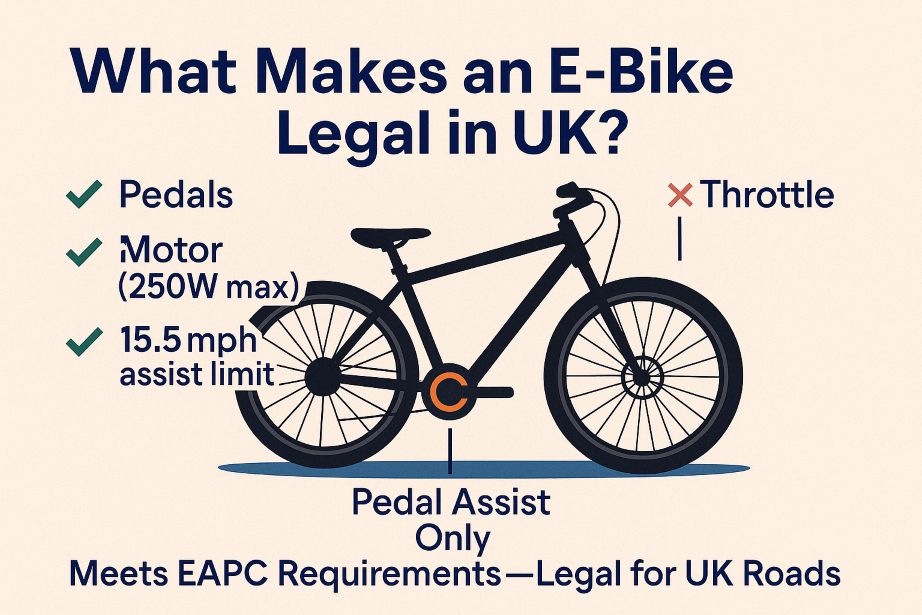
“Under UK law, legal EAPCs are capped at 250W continuous rated power, require working pedals, and must cut motor assistance at 15.5 mph (25 km/h).”
Department for Transport (DfT) EAPC Regulations
In the market for a compliant bike? Explore our verified UK road-legal e-bike deals and clearance sales.
Core UK EAPC Rules at a Glance
Continuous rated mechanical power. Peak wattage bursts on hill climbs may legally exceed this.
Motor assistance cuts off automatically at 15.5 mph. Leg pedalling speed is completely unrestricted.
No driving licence, CBT training, road tax, number plate, or DVLA registration required.
Allowed on public roads and cycle tracks. Strictly illegal on pedestrian pavements.
What is the Legal Speed Limit for Electric Bikes in the UK?
One of the most common questions British riders ask is: what is the speed limit for electric bikes? Under the Electrically Assisted Pedal Cycles Regulations 1983 (and modern amendments complying with BS EN 15194), the statutory legal speed limit for electric bikes in the UK is 15.5 mph (25 km/h) for motor assistance.
This 15.5 mph ceiling has very specific legal boundaries that every cyclist should understand:
Can You Legally Pedal Faster Than 15.5 mph?
Yes, absolutely. UK law does not impose a maximum speed on your legs. The regulation states strictly that the electric motor must stop providing electrical assistance once the bicycle reaches 15.5 mph. If you are fit enough to sprint at 25 mph on flat tarmac, or you are freewheeling down a hill at 35 mph, you are committing zero offences under EAPC law. The bike simply becomes an ordinary pedal cycle once the assistance cuts out.
Do Road Speed Limits Apply to Electric Bikes?
Under the Road Traffic Regulation Act 1984, standard highway speed limits (such as 20 mph, 30 mph, or 40 mph zones) apply specifically to motor vehicles. Because a compliant EAPC is legally classified as a pedal cycle and not a motor vehicle, road speed limits do not technically apply to cyclists.
However, cyclists can still be prosecuted under Section 28 of the Road Traffic Act 1988 for careless cycling, or under the Offences Against the Person Act 1861 for wanton or furious cycling if riding at excessive speeds that endanger pedestrians or other road users. Furthermore, local bylaws on royal parks, shared canal towpaths, and council promenade routes frequently enforce legally binding 10 mph or 15 mph local limits.
Rated Continuous Motor Output (250W) vs Peak Wattage Explained
When searching for the electric bike wattage law UK, many buyers get confused when they inspect spec sheets from leading motor manufacturers like Bosch, Shimano, Brose, and Yamaha. A premium e-bike will proudly advertise a 250W motor, yet online forums and dynamometer tests reveal peak power draws of 600W, 750W, or even 850W.
Does a motor that spikes above 250 watts break UK law? No, it is 100% legal. Here is the engineering distinction written into British standards:
Governed by standard BS EN 15194. This measures the maximum mechanical power a motor can output continuously over a sustained 30-minute laboratory test cycle without thermal overheating. This continuous thermal ceiling is what must not exceed 250W.
When accelerating from a standstill or climbing a brutal 20% incline, a motor draws maximum current from the battery for 10 to 30 seconds. A Bosch Performance Line CX draws around 600W to 750W peak, and a Specialized 2.2 motor peaks at 565W. As long as the rated continuous plate says 250W, it remains fully EAPC compliant.
Can You Legally Ride a 500W, 750W or 1000W E-Bike in the UK?
The short answer is an absolute no on public roads, cycle lanes, or pavements. Any electric two-wheeler with a continuous rated motor output exceeding 250W is not an EAPC under UK law. In the eyes of the Road Traffic Act 1988, it is legally classed as an unregistered motor vehicle (an L1e moped or electric motorcycle).
Why are UK retailers and online marketplaces allowed to sell 500W and 1000W bikes? Because it is entirely legal to import, buy, and sell high-powered electric bikes in the UK for use on private land, closed tracks, or for export. Retailers include disclaimer labels stating “For Off-Road Use Only”. The legal liability falls entirely upon the rider the second rubber touches public tarmac.
Thinking of Road-Registering a 500W+ E-Bike with the DVLA?
Because a 500W or 1000W e-bike is legally classed as a motor vehicle, some riders hope to add number plates, pass an MOT, and buy third-party road insurance to ride legally. However, standard bicycle frames and brakes run straight into the DVSA inspection trap. Read our complete guide on DVLA V5C registration, CBT licences, road tax, and why high-wattage e-bikes are practically impossible to insure:
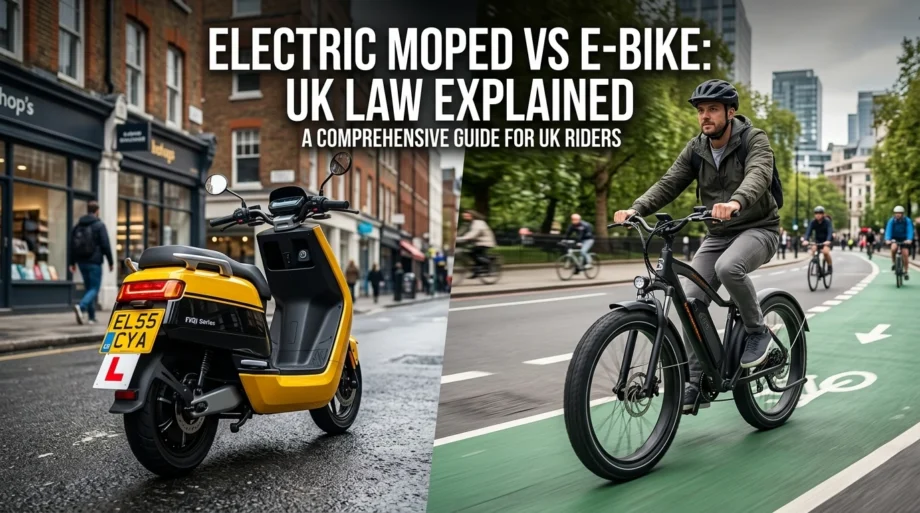
Read Electric Moped vs E-Bike UK Law: Registration & Tax Guide →Off-Road and Private Land Rules for High-Powered Electric Bikes
If you own a 500W, 750W, 1000W, or 1500W electric bicycle, the only place you can legally ride it without DVLA registration, tax, or a motorcycle licence is on genuinely private land. However, what constitutes “private land” under British law is far stricter than most people assume:
- Explicit Landowner Permission: You must have direct, verifiable permission from the landowner or tenant farmer. General assumptions or trespass do not grant legal immunity.
- Zero Public Rights of Way: The private land must not have any public footpaths, bridleways, or restricted byways crossing it. If a public right of way crosses private farmland, that path is subject to the Road Traffic Act, making an unregistered 1000W bike illegal.
- Physically Enclosed Boundary: The land must be physically gated or secured with no open public access. If the general public has unrestricted access (such as private retail car parks, university campuses, private industrial estates, or common land), the courts treat it as a public place under Section 192 of the Road Traffic Act.
- Forestry England & Trail Centres: Most commercial mountain bike trail centres and Forestry England estates explicitly ban electric bikes over 250W or bikes fitted with unassisted throttles from their waymarked trails.
Battery Runtime: How Long Will a 48V 13Ah Battery Last on a 1000W (or 1500W) E-Bike?
A query hundreds of conversion kit builders and off-road riders ask is: how long will a 48V 13Ah battery last on a 1000W motor?
To determine the exact runtime and mileage, we use fundamental electrical engineering. First, calculate the total energy capacity of the battery in Watt-hours (Wh):
Once you have total capacity (624 Wh), divide this figure by the continuous wattage drawn by the motor to find the theoretical runtime:
| Motor Power & Riding Style | Average Watt Draw | Continuous Runtime | Estimated Real-World Range |
|---|---|---|---|
| 1000W Motor: Full Throttle Continuous | 1000W continuous | ~37.4 Minutes (0.62 hours) | 12 to 16 miles (at ~25 mph) |
| 1500W Motor: Full Throttle Continuous | 1500W continuous | ~25.0 Minutes (0.41 hours) | 10 to 13 miles (at ~28 mph) |
| 1000W Motor: Mixed Pedal Assist (Level 2-3) | 250W to 350W average | ~2.0 to 2.5 Hours | 28 to 42 miles (at ~16 mph) |
| 250W Legal EAPC: Normal Pedal Assist | 120W to 180W average | ~3.5 to 5.2 Hours | 45 to 65 miles (at ~15 mph) |
Real-World Range Factors: Why do real-world figures vary? Under heavy 1000W discharge currents (around 20 to 25 Amps), lithium-ion cells experience voltage sag and increased internal resistance (Peukert’s effect), which wastes roughly 10% to 15% of nominal capacity as heat. Cold British winter temperatures (below 5°C), hilly terrain, fat 4-inch knobby tyres, and rider weights over 85kg will further reduce total throttle range.
Where Can You Legally Ride? (Roads, Cycle Paths & Pavements)
Because an EAPC is legally treated as a bicycle, you enjoy the exact same highway rights as any traditional cyclist:
- Public Carriageways: You can ride on all single and dual-carriageway roads across England, Wales, and Scotland. You are strictly banned from motorways (where all pedal cycles are prohibited).
- Cycle Tracks and Segregated Superhighways: Fully permitted. Any route open to pedal cycles is open to a compliant 250W electric bike.
- Bus Lanes: Permitted in almost all UK bus lanes (where cycling icons are displayed on the roadside blue signage).
- Pedestrian Pavements & Footpaths: Strictly illegal. Riding any bicycle or e-bike on a pedestrian footpath is an offence under Section 72 of the Highway Act 1835 (carrying a £50 Fixed Penalty Notice). If a footpath is designated as a shared-use track by the local authority with blue signs, you may ride on it, provided you yield to pedestrians.
- Bridleways & Byways: Fully permitted under the Countryside Act 1968, provided you give way to horse riders and walkers.
The Throttle Rule: Pre-2016 Grandfathering vs Modern Twist-and-Go
Can an electric bike have a throttle in the UK? The answer depends entirely on the date the bicycle was manufactured or first registered:
1. E-Bikes Manufactured Before 1 January 2016 (Grandfathered)
Under legacy UK EAPC rules, “twist and go” throttles that propelled the bike up to 15.5 mph without pedalling were completely legal. If your e-bike was manufactured before 1 January 2016, it is grandfathered under British law. You can legally continue riding it on public roads with a full-speed throttle.
2. E-Bikes Manufactured On or After 1 January 2016
Under revised European standard EN 15194 adopted into UK statutory law, a full-speed throttle is no longer permitted on an EAPC. A throttle may only provide electrical assistance up to 3.7 mph (6 km/h) without pedalling (known as “Walk Assist” to help push a heavy bike up a ramp or start off at traffic lights). Above 3.7 mph, the motor must cut off unless the pedals are actively turning.
DIY E-Bike Conversion Kits: Legal Limits & Build Rules
Converting an existing pedal bicycle with a front hub motor, rear hub motor, or mid-drive motor is 100% legal in the UK, provided the finished build strictly obeys the EAPC limits:
- Certified 250W Motor Stamping: Popular compliant kits include the 250W Bafang BBS01 mid-drive or 250W Yose Power hub systems. The motor casing should display a clear, permanent engraving or manufacturer sticker stating 250W and 15.5 mph / 25 km/h.
- Pedal Assist Sensor (PAS): You must fit a crank or bottom-bracket cadence/torque sensor so the motor only assists when pedalling.
- Disconnecting Throttle Levers: If your conversion kit includes a thumb throttle that powers the bike above walking speed, fitting that throttle makes the DIY conversion illegal for public road use.
- Battery Fire Safety: Always buy certified lithium batteries from reputable suppliers with genuine battery management systems (BMS) conforming to UKCA or CE safety standards.
Legal EAPC vs Illegal Moped Side-by-Side Comparison
Here is how British transport regulations distinguish a compliant road-legal pedal cycle from an illegal, unregistered electric moped:
| Feature / Specification | Legal UK EAPC | Illegal / Unregistered Bike |
|---|---|---|
| Motor Continuous Output | 250W continuous maximum (BS EN 15194) | Over 250W (500W, 750W, 1000W+) |
| Pedal Assistance | Mandatory (motor only assists when pedalling) | Throttle without pedalling above 3.7 mph |
| Assisted Cut-Off Speed | 15.5 mph (25 km/h) | Assists beyond 15.5 mph (20 to 35+ mph) |
| Driving Licence & CBT | None required (Age 14+) | Requires driving licence + CBT certificate |
| Road Tax & DVLA Logbook | None (£0 exempt, no registration) | Requires V5C logbook + number plate |
| Third-Party Motor Insurance | Not required | Legally mandatory (IN10 offence if absent) |
| Cycle Track Permissions | Permitted on all cycle tracks & bus lanes | Strictly prohibited on cycle tracks & paths |
Police Enforcement, Roadside Penalties & Court Driving Bans
How do traffic officers and dedicated police motorcycle units enforce electric bike laws? While bobbies on the beat do not carry portable wattmeters, police forces across South Wales, Greater Manchester, the West Midlands, and the Metropolitan Police actively deploy roadside roller dynos and mobile speed detection units.
If an officer stops you on a machine exceeding 250W continuous power or with an illegal throttle, here are the strict statutory penalties enforced under the Road Traffic Act:
- Section 165A Vehicle Seizure: The police have immediate statutory power to seize and impound any uninsured motor vehicle on the spot. Standard release fees start at £150 plus £20 per day in storage fees.
- 6 to 8 Penalty Points for No Insurance (IN10): Driving without third-party insurance is a strict liability offence. Under the Road Traffic (New Drivers) Act 1995, if you accumulate 6 points within the first 2 years of passing your driving test, your driving licence is automatically revoked.
- £300 Fixed Penalty Fine: Standard roadside fixed penalty notice for no insurance.
- Vehicle Crushing: Because an unregistered 1000W DIY e-bike cannot be insured or registered without passing an MSVA motorcycle test, owners are unable to produce valid insurance within 14 days at the police pound. By law, the vehicle is crushed.
- Driving While Disqualified: If you are serving a court-ordered driving ban and ride an unrestricted or 500W+ e-bike, you commit the serious criminal offence of Driving While Disqualified under Section 103, carrying potential custodial prison sentences up to 6 months.
Frequently Asked Questions About UK E-Bike Law
Related Guides & Practical Resources
DVLA registration, V5C logbooks, CBT training, and moped insurance explained.
Live discounts on 100% road-legal electric bikes from verified UK retailers.
Stealth hub caps, puncture liners, and road-legal styling upgrades.
Rental trial rules vs privately owned e-scooter legislation.