Cut through the jargon. An electric bike (e-bike) is not an electric motorbike, and you don’t twist a throttle to glide down the bypass at 40 mph. It is an ordinary pedal cycle fitted with a smart motor and battery that amplifies your own pedal power. Here is the definitive breakdown of how they work, what every component does, and how to choose the right setup for UK roads.
⚡ THE 10-SECOND SUMMARY: WHAT MAKES AN E-BIKE?
Under UK law, an e-bike (legally an EAPC) adds electric assistance only when you pedal. You still pedal, change gears, and steer like a normal bicycle—the motor simply flattens headwinds and steep hills.
🔋
Battery
Lithium pack storing 360Wh to 750Wh of electrical juice.
⚙️
Motor
250W continuous rated, hub-mounted or at the pedals.
📡
Sensors
Measures cadence or pedal pressure to match your effort.
💻
Controller
The onboard brain managing smooth power and 15.5 mph cutoff.
Anatomy of an E-Bike: Component by Component
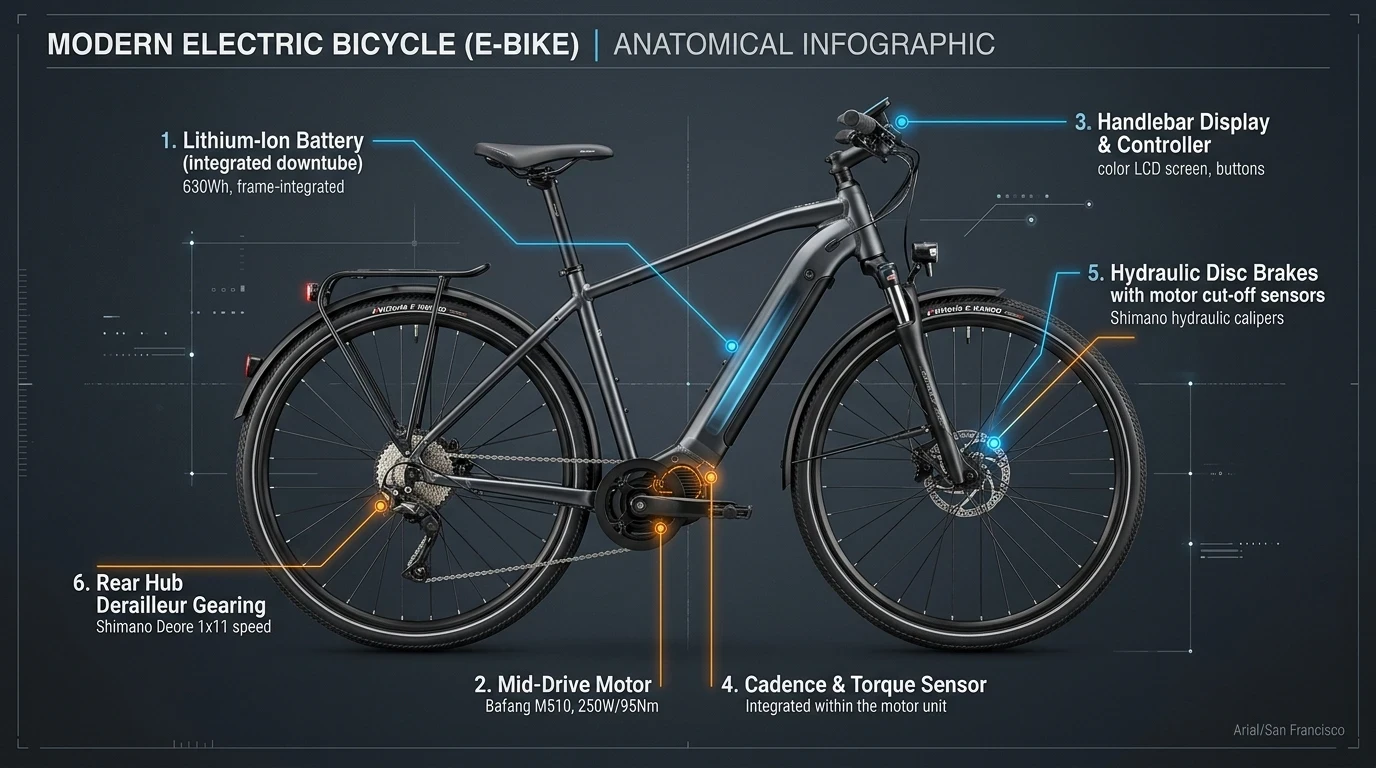
While a conventional bicycle relies purely on human quadriceps, chains, and sprockets, an e-bike integrates four electronic systems into the traditional frame geometry. Here is the complete anatomical breakdown:
1. Integrated Battery (The Fuel Tank)
Mounted inside or along the downtube. Capacity is measured in Watt-Hours (Wh): Volts × Amp-Hours. A typical 36V 14Ah battery provides roughly 504Wh, delivering 30–50 real-world miles per charge. (For comprehensive UK safety and storage statistics, see our report on why over half of e-bike battery fires start off the charger).
2. Mid-Drive Motor (The Muscle)
Positioned right at the bottom bracket between the pedals. It drives the chain directly, leveraging the bike’s rear gears for maximum hill-climbing torque (up to 85–95Nm).
3. Handlebar Display & Remote
Allows the rider to toggle assist levels (Eco, Tour, Sport, Turbo), monitor real-time speed, battery percentage, and engage walk-assist mode.
4. Torque & Cadence Sensors
The system’s nervous system. Cadence sensors detect if the cranks are spinning; torque sensors measure how hard you push down and match your effort instantly.
5. Hydraulic Disc Brakes
Crucial for safety. E-bikes weigh 20kg–28kg and sustain higher average speeds. Hydraulic calipers provide reliable, fade-free stopping power in wet UK weather.
6. Rear Derailleur / Hub Gearing
Standard bicycle drivetrain (Shimano / SRAM). Shifting into a low gear allows both rider and motor to spin at their most efficient cadence up steep hills.
How Does Pedal Assist Actually Feel? (Cadence vs Torque)
The biggest misconception newcomers have is that an e-bike does all the work while you sit passively. In reality, e-bikes use Pedal Assist Systems (PAS). How natural or unnatural that feels depends entirely on the sensor technology:
Cadence Sensor (Budget-Friendly)
Common on entry-level e-bikes under £1,200.
- How it works: A ring of magnets detects pedal movement. Once you spin the pedals half a turn, the motor switches on like a light switch.
- The feel: Can feel like a “surge” or “ghost pedalling” where your legs spin freely without resistance while the motor pushes.
- Best for: Flat commutes, leisure paths, and budget-conscious riders.
Torque Sensor (Natural & Intuitive)
Standard on mid-drive and premium e-bikes (Bosch, Shimano, Bafang M-series).
- How it works: A precision strain gauge measures how hard you push down on the pedals in real time.
- The feel: Feels like you suddenly have bionic legs. Push lightly, and the motor purrs gently; stomp on a hill, and it instantly unleashes full power.
- Best for: Hilly terrain (Sheffield, Peak District), gravel, cargo, and keen cyclists.
Hub Motor vs Mid-Drive: Which is Right for You?
Where the motor sits fundamentally determines how the bike handles and climbs:
Rear Hub Motors: Built directly into the centre of the rear wheel. They are mechanically simple, affordable, and don’t put extra wear on your bike chain. However, because they cannot use the bike’s rear gears to multiply torque, they can bog down and drain battery rapidly on steep 15%+ inclines.
Mid-Drive Motors: Located in the centre of the frame at the bottom bracket. Because the motor drives the chain, you can shift into 1st gear on a steep hill, allowing the motor to spin at its optimum RPM. If you live anywhere with serious hills, a mid-drive motor is night-and-day superior.
Is an Electric Bike Road Legal in the UK?
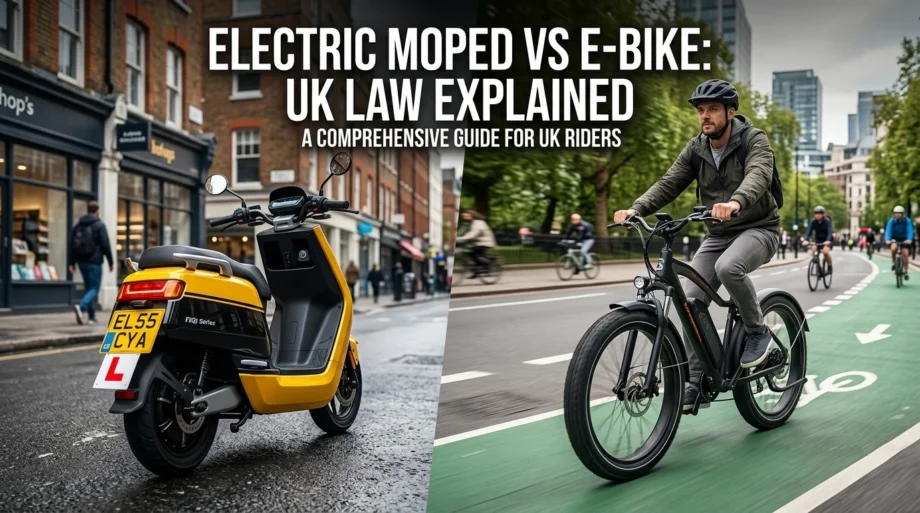
In Great Britain, you do not need a driving licence, CBT test, road tax, or DVLA registration to ride an e-bike, provided it meets the Electrically Assisted Pedal Cycle (EAPC) standard:
🇬🇧 The Golden Rules of UK E-Bike Legality:
- Motor Power: Maximum continuous rated power of 250 Watts.
- Assisted Speed Cut-off: Electrical assistance must cut out when you reach 15.5 mph (25 km/h).
- Pedal Activation: Motor must only assist when pedals are turning. (Full-speed twist throttles without pedalling are illegal on public roads).
- Rider Age: You must be 14 years or older.
📚 Explore Our In-Depth E-Bike Guides
Now that you know the basics, dive deeper into our specialised guides to make the right buying decision:
How to Choose the Best E-Bike ➔
Hybrid, folding, mountain, or road? Match your budget and riding lifestyle.
Calculate Real Battery Runtime ➔
Our interactive calculator estimating range based on rider weight, hills & Wh.
UK E-Bike Law: 250W vs 1000W ➔
What happens if you ride an uncertified 750W/1000W throttle bike in the UK.
E-Bike Cost Savings Calculator ➔
See how much you save swapping petrol or train fares for an e-bike commute.
Frequently Asked Questions
Do you still get exercise on an electric bike?
Yes, absolutely. Studies from Oxford and Leeds universities consistently show that e-bike riders get comparable aerobic workouts to regular cyclists because they ride more often, tackle bigger hills, and travel significantly longer distances.
How long does an e-bike battery take to charge?
A standard 500Wh battery takes roughly 4 to 6 hours from completely empty to 100% using a standard UK 3-pin mains charger, costing about 15p to 20p in electricity.
What happens if the battery dies while riding?
An e-bike simply reverts to being a normal pushbike. You can pedal home using standard bicycle gears, though the bike will feel noticeably heavier (usually 20–25kg) without motor assistance.