E-Bikes · Analysis
Just over half the e-bike and e-scooter fires reported to the government’s product safety office in 2025 started when the battery wasn’t charging. The advice never to charge overnight still matters. It covers about half the problem.
Key findings
- In 2025, 93 of the 179 fires with a recorded charging status started while the battery wasn’t on charge: 52%, up from 41% in 2023.
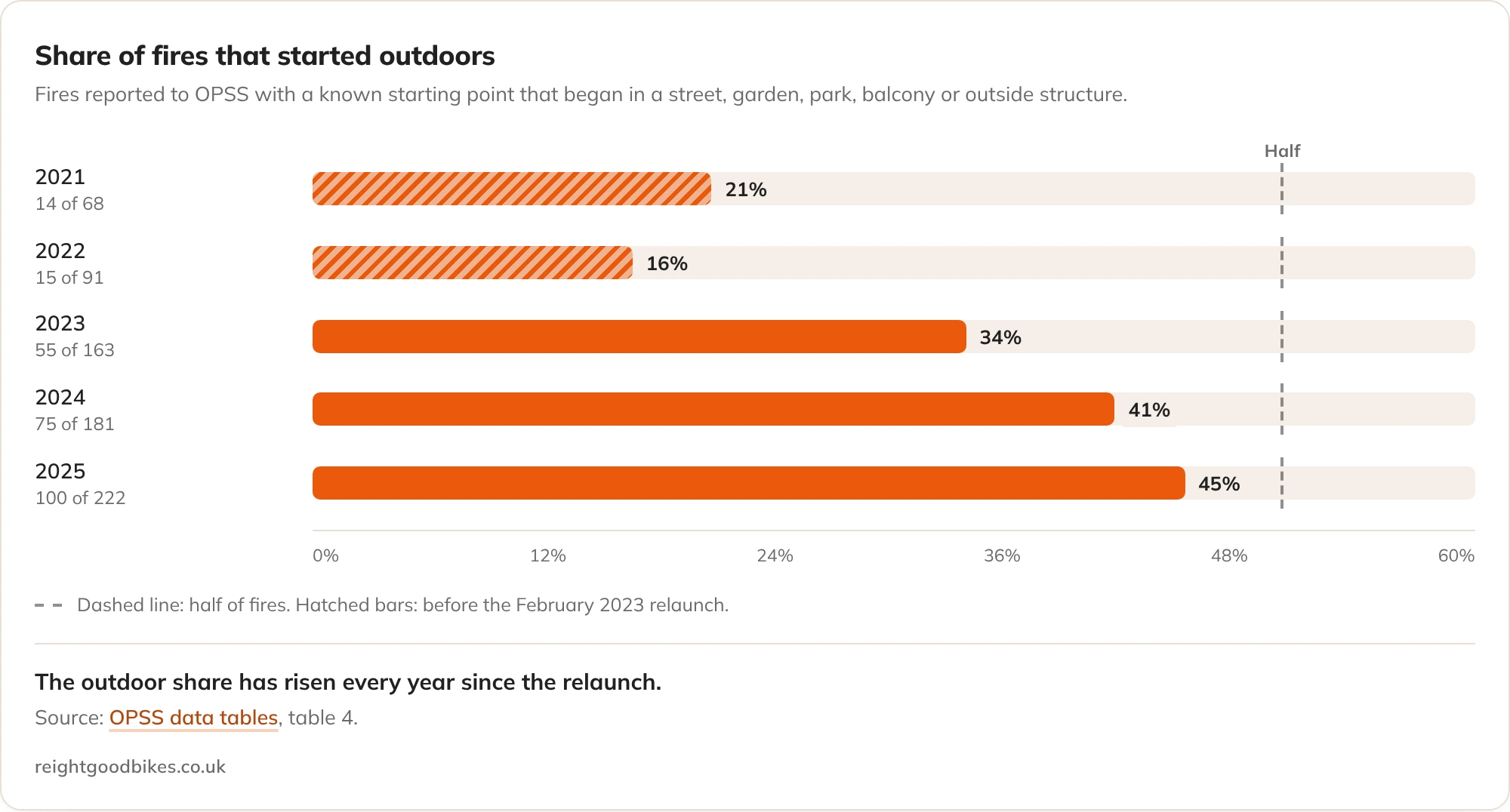
- 100 of the 222 fires with a known starting point began outdoors (45%), most of them in streets and gardens. In 2023 it was 34%.
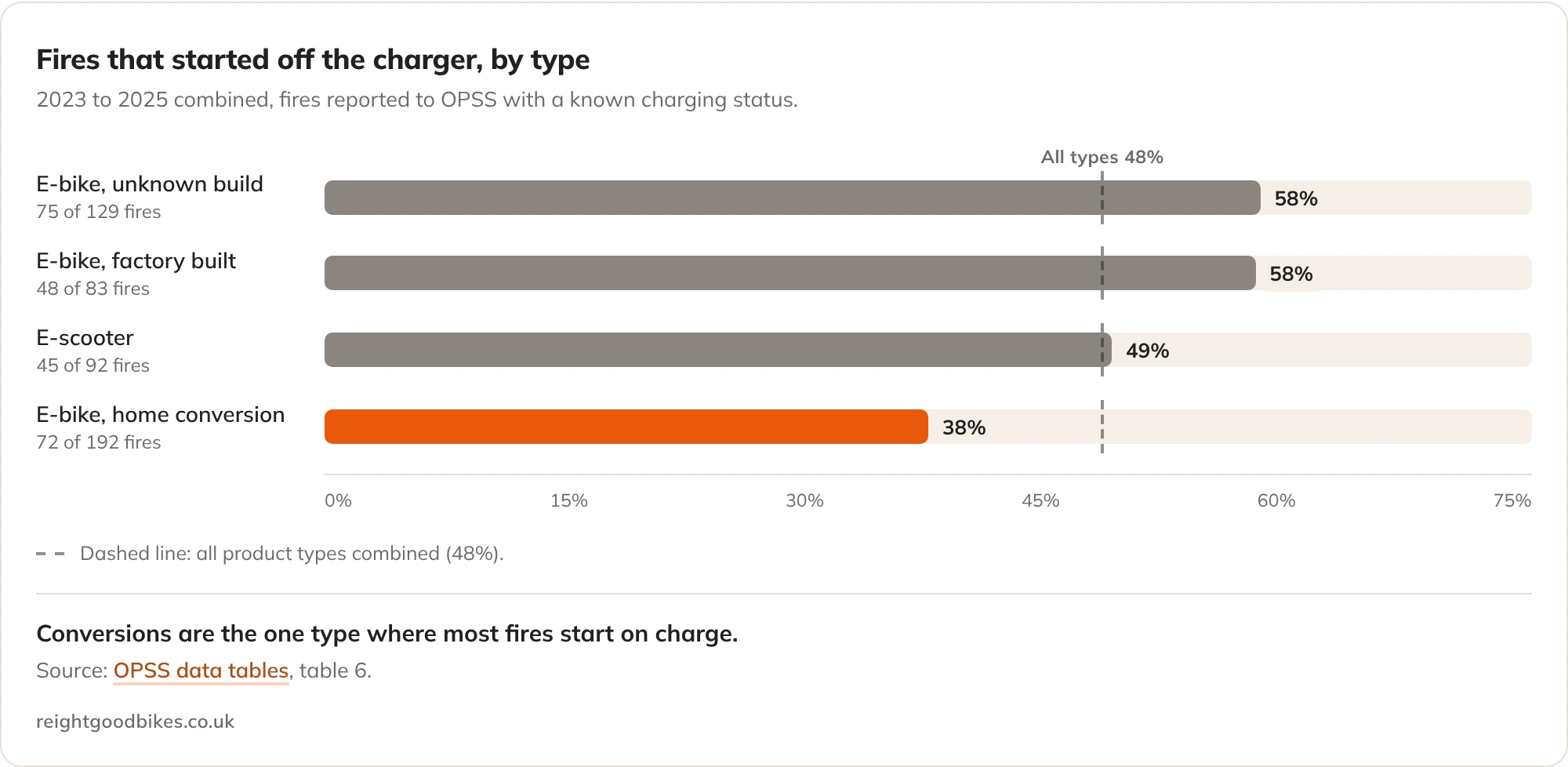
- Home conversions are the exception. Across 2023 to 2025, 63% of their fires started on charge, against 42% for factory-built e-bikes.
- Reported injuries rose again to 98. Reported deaths fell from 10 in 2023 to 2 in 2025.
Off the chargerOutdoorsConversionsInjuriesWhat to doHow we worked it out
Nearly every e-bike fire warning says the same thing. Don’t charge it overnight, don’t charge it in the hallway, unplug it when it’s full. That advice is sound. Two of this autumn’s worst fires, in Bootle and in Bow, both involved a battery on charge.
But the government’s latest fire figures, published on 30 September, show something the warnings mostly skip. Last year, more of the reported fires started when the battery wasn’t plugged in than when it was.
The Office for Product Safety and Standards (OPSS) collects reports of e-bike and e-scooter fires from fire services across the UK. We took its data tables for 2017 to 2025 and tracked how the picture has moved since it relaunched the reporting system in 2023. Below: where fires now start, which bikes burn on the charger, and what that means for where you keep yours.
More than half of fires now start off the charger
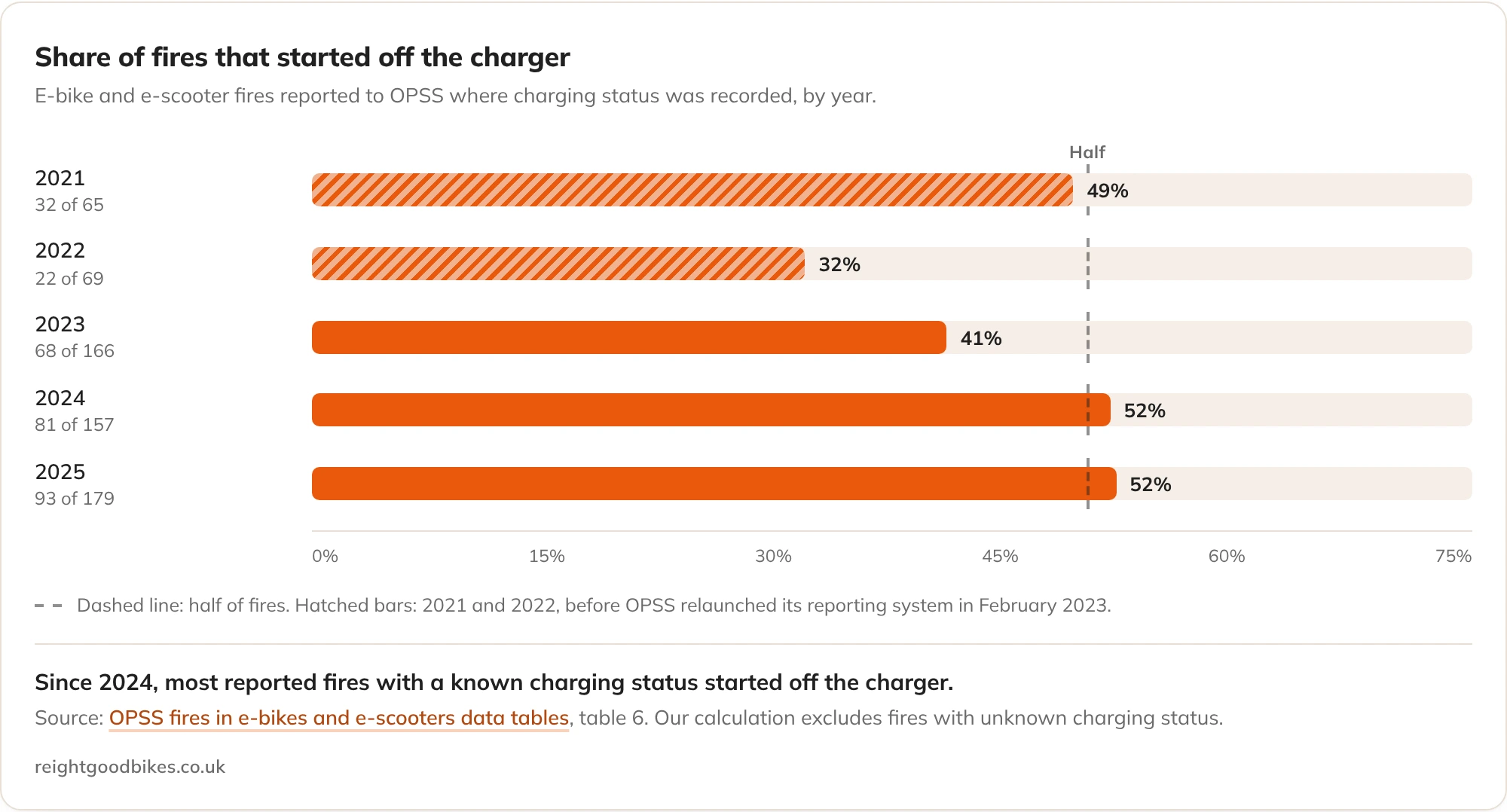
OPSS records whether the battery was charging when the fire started. In a third of 2025 cases nobody could tell. Leave those out and the split is 86 fires on charge and 93 not charging. That’s 52%.
In 2023, the first year after the reporting system was relaunched, the figure was 41%. It passed half in 2024 and stayed there.
Share of fires that started off the charger
E-bike and e-scooter fires reported to OPSS where charging status was recorded, by year.
Dashed line: half of fires. Hatched bars: 2021 and 2022, before OPSS relaunched its reporting system in February 2023.
reightgoodbikes.co.ukDownload WebP
Off-charger share = fires not charging ÷ (fires on charge + fires not charging)
2025: 93 ÷ (86 + 93) = 52%. Fires with unknown charging status (88 in the data tables) are left out. OPSS’s written report gives 92 of 178; its own table adds up to 93 of 179. Either way it rounds to 52%.
A fire that starts off the charger isn’t a mystery. London Fire Brigade says batteries fail when they’re badly built, fake or damaged, as well as when they’re overcharged or used with the wrong charger. Only the last two need a plug in the wall.
More than four in ten fires now start outdoors
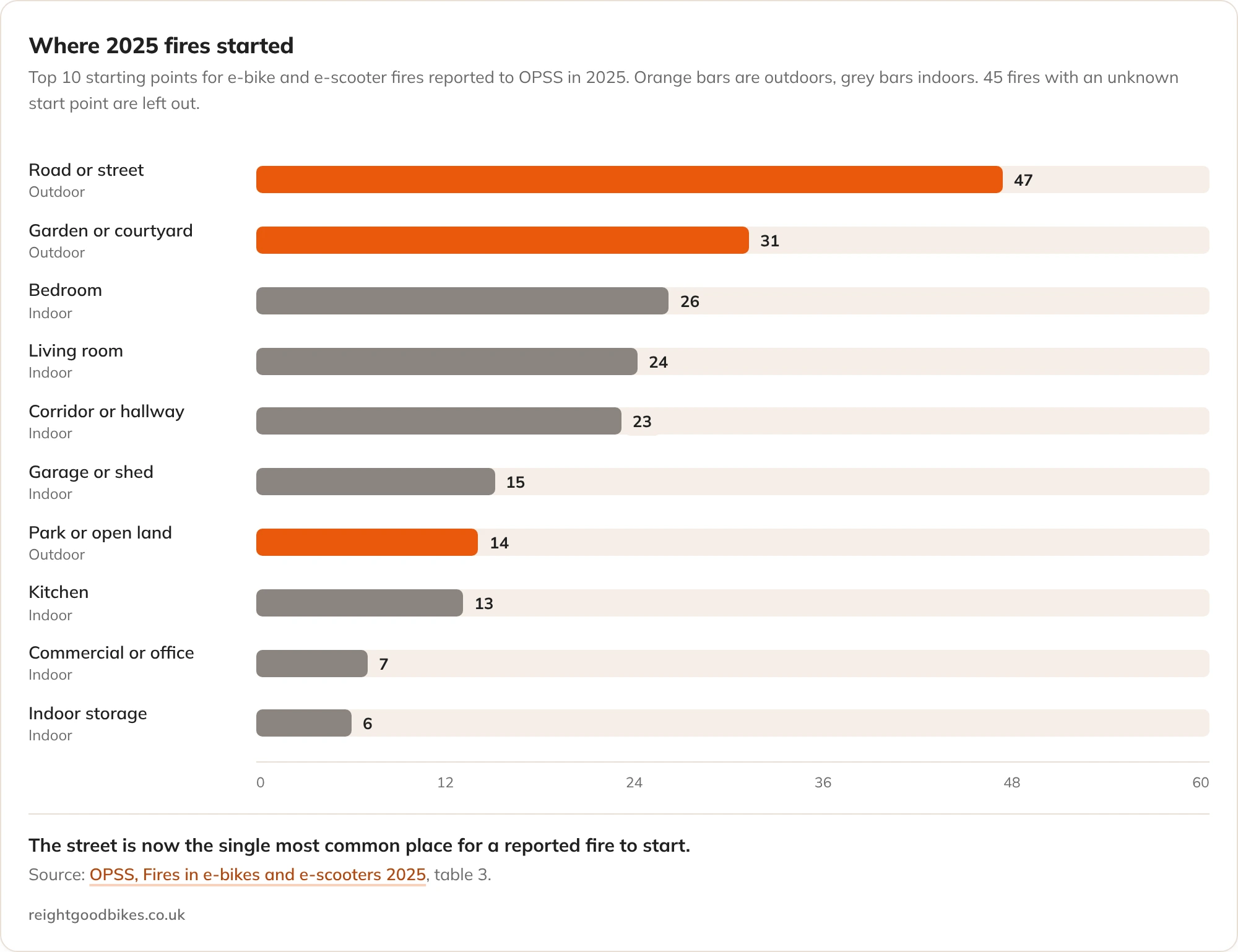
The second shift is where fires begin. In 2025, 100 of the 222 fires with a known starting point began outside: 47 in a road or street, 31 in a garden or courtyard, 14 in a park and 8 on balconies or outside structures. That’s 45%, up from 34% in 2023.
Share of fires that started outdoors
Fires reported to OPSS with a known starting point that began in a street, garden, park, balcony or outside structure.
Dashed line: half of fires. Hatched bars: before the February 2023 relaunch.
reightgoodbikes.co.ukDownload WebP
The data doesn’t record why. More bikes being ridden and parked outside every day is the obvious candidate, but these figures can’t prove it.
Where 2025 fires started
Top 10 starting points for e-bike and e-scooter fires reported to OPSS in 2025. Orange bars are outdoors, grey bars indoors. 45 fires with an unknown start point are left out.
reightgoodbikes.co.ukDownload WebP
Indoor fires haven’t gone away. Bedrooms, living rooms and hallways still accounted for 73 fires between them, and those are the ones that trap people. Merseyside Fire and Rescue Service’s own count of lithium-ion battery fires points the same way as the national data: of 150 since April 2023, it says almost half were in the home.
“This incident highlights why you should always ensure your escape route is clear and why we recommend never storing an e-bike or e-scooter on your means of escape, such as a hallway or by your front door.”Richard Field, Deputy Assistant Commissioner, London Fire Brigade, after a fire in Bow, September 2026
Home conversions are the bikes that burn on the charger
Split the figures by type of bike and the pattern changes. We pooled 2023 to 2025 to get bigger numbers. Of 192 conversion fires with a known charging status, 120 started on charge: 63%. Unlike factory-built pedelecs meeting strict UK EAPC e-bike laws, DIY conversions frequently bypass standard motor cutoffs and thermal protections. For factory-built e-bikes it was 35 of 83, or 42%.
Fires that started off the charger, by type
2023 to 2025 combined, fires reported to OPSS with a known charging status.
Dashed line: all product types combined (48%).
reightgoodbikes.co.ukDownload WebP
Pooled share = fires not charging (2023 + 2024 + 2025) ÷ fires with known status (2023 + 2024 + 2025)
Factory built: 48 ÷ 83 = 58%. Conversions: 72 ÷ 192 = 38%. Pooling three years gives each type at least 83 fires to work with, against as few as 31 in a single year.
Conversions are also a big slice of the total. In 2025, 82 of the 119 e-bike fires where the build was known involved a converted bike: 69%. That doesn’t prove a conversion is riskier than a factory bike, because nobody counts how many of each are on the road. It does show where fire services keep finding the problem.
“The biggest problem that we’re seeing is sub-standard versions of these batteries, quite often bought from third-party sellers on online market places. (If you are considering an extra power pack, read our guide on whether you should buy a second e-bike battery before purchasing).”Giuseppe Capanna, Electrical Safety First, speaking to BBC Radio 5 Live, September 2026
Cheap batteries turn up in more places than the conversion kit market. We’ve shown why the £79.90 e-bikes advertised on TikTok can’t contain the battery they claim.
From our own experience in Sheffield repairing and servicing e-bikes: the vast majority of dangerous battery failures we see come from unbranded conversion kits bought off marketplace platforms. They’re often paired with mismatched 54.6V chargers that lack thermal cutoff protections, wrapped in generic heat shrink without proper cell spacing.
More people hurt, fewer killed
Reported injuries rose to 98 in 2025, the highest in the series. Reported deaths fell from 10 in 2023 to 2. OPSS says both counts only include cases fire services told it about, so the real figures may be higher.
| Year | Fires reported | From London | People injured | People killed |
|---|---|---|---|---|
| 2021 | 81 | 80 | 33 | 0 |
| 2022 | 95 | 87 | 61 | 3 |
| 2023 | 205 | 176 | 78 | 10 |
| 2024 | 209 | 174 | 86 | 7 |
| 2025 | 267 | 214 | 98 | 2 |
The London column explains why we compare shares rather than totals. London Fire Brigade sent 99% of reports in 2021 and 80% in 2025, as more fire services joined in. Some of the rise in fires is better reporting, not more fires. London’s own count tells a similar story: the Brigade attended a record 206 e-bike and e-scooter fires in 2025.
2026 has already been worse for deaths. In Bootle on 22 September, a mother and three of her children died in a fire where investigators found an e-scooter battery on charge.
“They can enter a process that’s known as thermal runaway and that’s basically where the battery will really rapidly overheat and it’ll create a really nasty intense fire. They can spread very, very quickly.”Becky Guy, Senior Policy Manager, RoSPA, to BBC North West Tonight, September 2026
Store it as carefully as you charge it
None of this makes the charging advice wrong. A third of reported fires still started on charge, and conversions mostly burn there. The data just says storage, damage and where the bike lives between rides matter about as much.
If you charge indoors
Charge while you’re awake and nearby, unplug when it’s full, and only use the charger that came with the battery. Fit a smoke alarm in the room where you charge.
If the bike lives in a hallway
Move it. About half of fires start off the charger, so a parked bike is still a risk, and a hallway is often the only way out. A room with a door you can shut is safer, or a locked garage or secure shed.
If you’ve crashed or the battery got soaked
Check it before it goes back indoors. Merseyside’s fire service lists swelling, hissing or cracking, a strange smell and a battery that won’t charge properly as warning signs. Our guide to battery care and storage covers heat and cold.
If you ride a conversion
Get it fitted by a bike shop or a competent professional, not a YouTube video, and buy the battery new from a reputable UK seller. That’s London Fire Brigade’s advice, and the charging figures back it up.
Cite this analysis
Reight Good Bikes (2026). “E-Bike Fires: Half Now Start Off the Charger”. https://reightgoodbikes.co.uk/ebike-fires-off-charger/
Charts and data are free to reuse with a link to this page.
Sources
- Office for Product Safety and Standards, “Fires in e-bikes and e-scooters – 2025” (30 September 2026) and the accompanying data tables, 2017 to 2025: tables 1 to 8, covering fires by fire service, product type, location, charging status, injuries and deaths.
- London Fire Brigade, “E-bike fire – Bow” (September 2026): Richard Field quote and storage advice.
- London Fire Brigade, “London faces record number of e-bike fires in 2025” (October 2025): reasons batteries fail.
- London Fire Brigade, “Record number of e-bike and e-scooter fires across London in 2025” (January 2026): 206 fires in 2025.
- BBC News, “What can I do to prevent e-bike and e-scooter battery fires?” (30 September 2026): Merseyside Fire and Rescue Service figures and warning signs, Becky Guy and Giuseppe Capanna quotes, Bootle fire.
Calculations are Reight Good Bikes’ own, derived from the OPSS data tables published at the end of September 2026. OPSS collects these reports voluntarily from fire and rescue services, so the figures are not a national count and cannot rank fire services. Most reports come from London. Because more fire services have joined since OPSS relaunched the scheme in February 2023, we compare shares rather than raw totals, and treat 2023 as the start of the comparable series. Shares exclude fires where the charging status or starting point was unknown. “Outdoors” means a fire that started in a road or street, garden or courtyard, park or open land, balcony or walkway, or external structure, matching OPSS’s own grouping. Product-type shares pool 2023 to 2025. Injury and death counts only include cases reported to OPSS. Last checked: 2 October 2026.